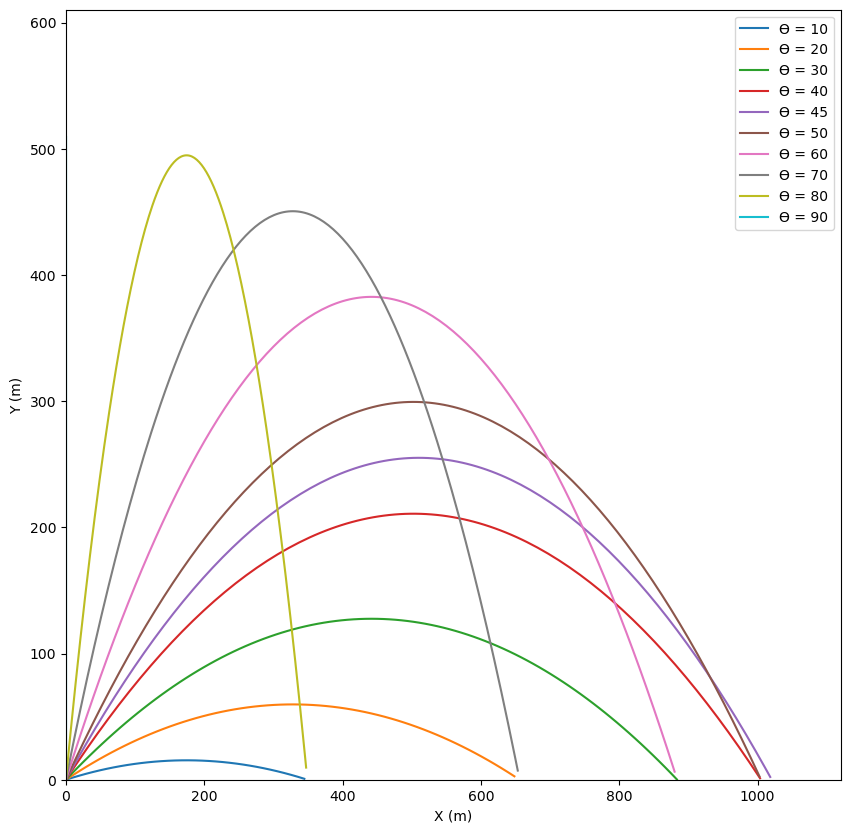
A projectile is launched with velocity \(v_0\) at an angle θ to the horizontal. We want to investigate and analyze its trajectory and study the effect of changing the launch angle θ. We illustrate it visually for a clearer understanding.
1. Maximum Height
For finding maximum height \(h\) reached by the projectile, we consider motion in vertical direction i.e. along y-axis.
This gives either \(t = 0\) (not the valid root we need) or
\[
v_0sinθ - \frac{1}{2}gt = 0
\]
Thus, the time of flight is as below :-
\[\Large t = \frac{2v_0sinθ}{g}\]
3. Range
For finding the range \(s\) or the distance where the projectile lands on the ground, we consider motion in horizontal direction i.e. along x-axis.
Initial Velocity = \(v_0cosθ\)
Time of Flight = \(\Large \frac{2v_0sinθ}{g}\) (from section 2)
\[
s = ut
\]
\[
= \frac{(v_0cosθ)(2v_0sinθ)}{g}
\]
\[
= \frac{2v_0^2sinθcosθ}{g}
\]
\[
= \frac{v_0^2sin2θ}{g}
\]
i.e.
\[\Large s = \frac{v_0^2sin2θ}{g}\]
4. Visual Plots
Using the equations derived in sections 1, 2 and 3, we can compute the trajectory of the projectile and plot it.
Using time as the independent variable, we generate \(x\) and \(y\) and plot \(y\) versus \(x\) for a range of values of \(\theta\) from \(10^{\circ}\) to \(90^{\circ}\). We use \(g = 9.8 m/s^2\) and \(v_0 = 100 m/s\)
Code
# Compute pointsdef plot_trajectory(theta): theta_rad = (theta * math.pi) /180 x = [] y = [] t =0 t_step =0.1 t_flight = (2* V * math.sin(theta_rad)) / gwhile t < t_flight: x_t = V * t * math.cos(theta_rad) y_t = V * t * math.sin(theta_rad) -0.5* g * t * t#print("t=%.2f x=%.2f y = %.2f" % (t, x_t, y_t)) x.append(x_t) y.append(y_t) t = t + t_step plt.plot(x, y, label='ϴ = '+str(theta))# Constants g =9.8V =100# Plotx_lim = V*V/g +100y_lim = V*V/(2*g) +100fig, ax = plt.subplots(1, figsize=(10,10))ax.set_xlim(0, x_lim)ax.set_ylim(0, y_lim)ax.set_xlabel("X (m)")ax.set_ylabel("Y (m)")theta_list = [10, 20, 30, 40, 45, 50, 60, 70, 80, 90]for theta in theta_list: plot_trajectory(theta)_ = ax.legend(loc="upper right")
5. Animation of Trajectory
Finally, we animate the trajectory of the projectile for a certain value of \(\theta = 45^{\circ}\). It is easy to change \({\theta}\) and run the animation for various other values of \({\theta}\)
Code
# Compute pointsdef compute_trajectory(v, theta, x, y, num_points): theta_rad = theta * math.pi /180 t_flight = (2* v * math.sin(theta_rad)) / g num_points =100 t_step = (t_flight/num_points) t =0while t < t_flight: x_t = v * t * math.cos(theta_rad) y_t = v * t * math.sin(theta_rad) -0.5* g * t * t#print("t=%.2f x=%.2f y = %.2f" % (t, x_t, y_t)) x.append(x_t) y.append(y_t) t = t + t_stepreturn t_flight